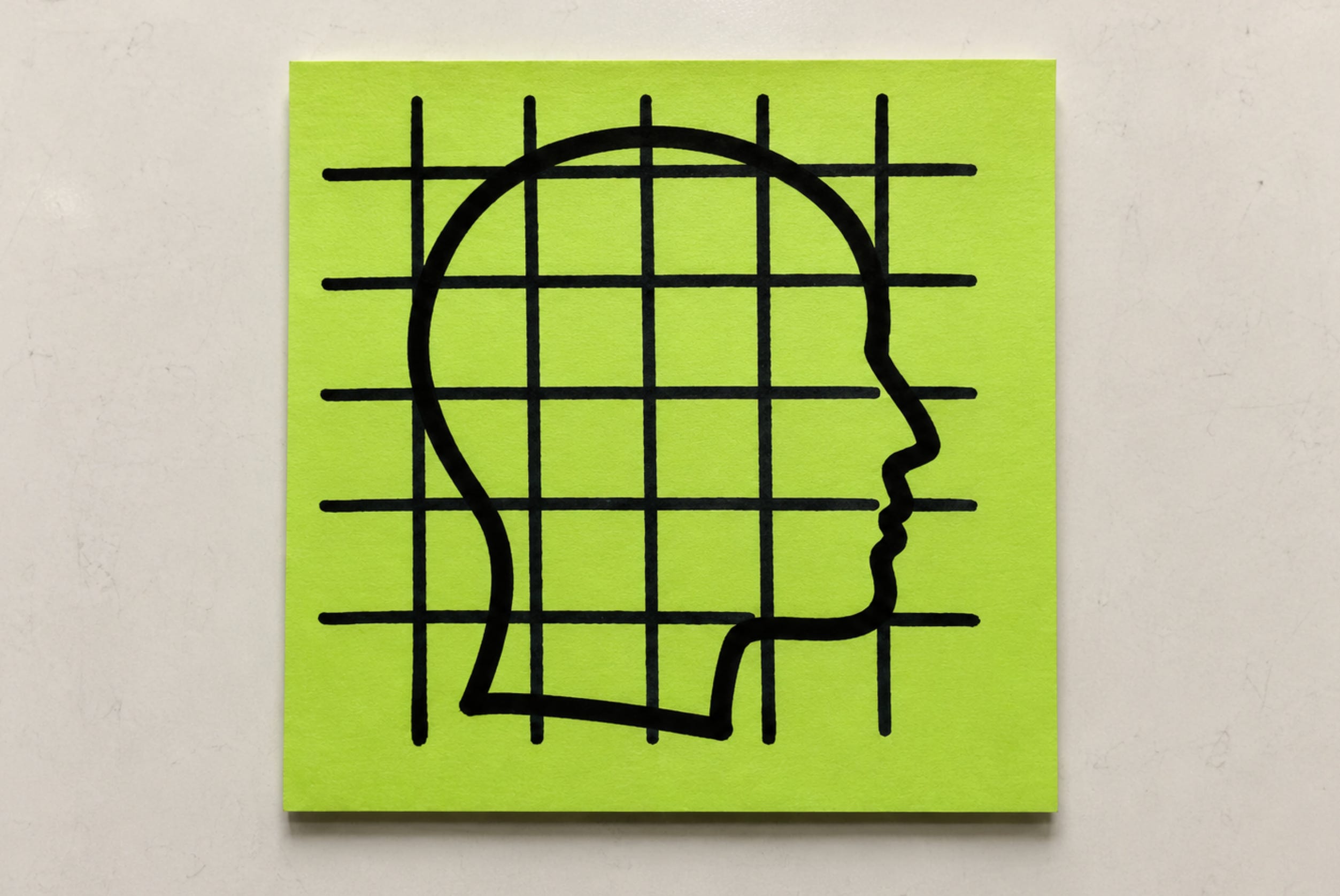
Design is built on an illusion. It’s not the illusion that design is neutral, or innocent, or a force for good. Not the comforting fiction that, because we design with human-centricity, we are the competent and kind ‘good guys’ building a better world.
No. There’s a deeper illusion.
It’s the illusion that the world is just so available to us, ready to be mapped and mastered. That we have it conceptually right, that it fits all our abstract notions of what it is and how it works. That people can be reduced to ‘users,’ ‘stakeholders,’ ‘personas,’ and ‘segments.’ That organizations are ‘value chains,’ ‘operating models,’ and ‘maturity stages.’ That change unfolds in phases, people follow ‘adoption curves,’ readiness can be measured, and transformation can be orchestrated. That problems have ‘root causes’ and can be captured in a tidy ‘problem statement.’ That human behavior is predictable if only we gather enough data. That value can be modeled. That what is ‘good’ can be codified, and organizational values operationalized. The illusion is all-encompassing. It is the quiet conviction that reality is first ours to conceptually define.
It’s the illusion that the world is just there—populated by people, pressures, decisions, and consequences—and that our vocation is to tame it by constructing maps, models, matrices, frameworks, lifecycles, and curves to sort the chaos and render it intelligible. But in doing so, we have already made a fundamental decision about the world: that meaning does not arise from the world itself, that meaning is not encountered, but manufactured by our conceptual ordering. We have quietly replaced what is given with what we generate.
At this point, our abstract models cease to be mere tools. They become the locus of truth.1 They do not simply describe reality; they decide in advance what reality is permitted to be. Our frameworks and models dictate what we see, what we measure, what is actionable, and what is dismissible. Reality itself—what is actually real—loses its authority. It becomes raw material for a higher-order ‘truth,’ for what we now believe to be truly real, as rendered by our model. The model becomes the judge, and reality is pushed aside.
Abstractions crave stability. Once a conceptual model ‘explains reality,’ it begins to claim authority. Reality must now conform to the model. The maps, models, and frameworks harden into systems, processes, operating models, ministry models, governance structures, decision rights, metrics, and enforcement mechanisms. The abstraction incarnates itself in the very architecture of our organizations.
Why is this?
This happens because once we possess a governing truth, we want it to endure. So we design and build systems to mirror our models and frameworks, treating our conceptually constructed world as more real than the world given to us. Our conceptually abstracted frameworks and playbooks always seek embodiment in systems. They cannot rule without incarnation.
Eventually, ‘truth’ migrates from the world God has spoken into existence—the world He has given—to the engineered order we have constructed. In our designed-and-engineered reality, where our conceptually abstracted frameworks masquerade as truth, Christ is reduced to an optional inspiration, a spiritual accent, an ethical guardrail—permitted only if He fits within the system we have enthroned.
Why Christ becomes diminished in engineered realities.
Christ is not a principle or a concept like the ones behind our engineered realities. He is a living Person who addresses us—not our systems, not our infrastructure.2 Frameworks and models cannot repent. Processes cannot obey. They can only be applied. Only persons can respond to the living Lord.
So once authority is vested in the engineered order, our decisions are made by the process. Our legitimacy comes from alignment with the engineered order. Our obedience is reduced to compliance. Faithfulness is collapsed into execution. The living call of Christ is replaced by the logic of the system.
CASE STUDY 01 :: CHRIST BECOMES A GUEST IN A HOUSE BUILT ON ABSTRACTION.
Willow Creek Community Church became one of the most influential churches in North America because it wanted to reach people who were not being reached. It asked why people did not go to church. It removed needless barriers. It constructed a vast architecture of ministries, programs, services, environments, leadership structures, and teaching strategies, all calibrated to the seeker. Shaped by secular business methods, It did what modern leadership knows how to do: it identified a problem, built a model, scaled the model, measured participation, and taught others to do the same. More than twelve thousand churches in the Willow Creek Association looked to it for guidance.
The aim was discipleship—lives awakened to Christ, growing in Christ, and serving through Christ. The name of Jesus saturated their vision, their strategy, their prayers. He was confessed as the animating center.
But over time, the ministry architecture became Willow Creek’s way of knowing. The structure became the lens through which reality was discerned.
Greg Hawkins, Willow Creek’s executive pastor, described the operative assumption with disarming clarity: “Participation is a big deal.” The logic was simple enough. The church creates programs and activities. People participate in them. Increased participation produces disciples of Christ. And, according to Hawkins, “We measure levels of participation.”
And there it is.
Counting isn’t knowing.
Growth in Christ was rendered visible by participation. Participation could be counted. Attendance could be counted. Serving could be counted. Small-group involvement could be counted. Program engagement could be counted. And because it could be counted, it could be managed. Because it could be managed, it could be scaled. Because it could be scaled, it could become the model. And because it became the model, it began to tell the church what reality was.
And then Willow Creek studied itself.
The research was published under the title Reveal: Where Are You? The study surveyed Willow Creek and six other churches, analyzing thousands of responses and more than one hundred interviews. Bill Hybels, the founding and senior pastor of Willow Creek Community Church, called the findings “earth shaking.”
What did they find?
Reality disappears inside success.
They found that involvement in church activities was not necessarily accompanied by spiritual growth. They found that Willow Creek wasn’t having much effect among those ‘close to Christ’ or ‘Christ-centered.’ A significant portion of mature believers said they were stalled in their spiritual growth, dissatisfied with church, and considering an exit.
Seventeen thousand people gathered in worship at Willow Creek, and twelve thousand churches patterned themselves after its design. So, the total count of people in this finding was not a minor tremor. It was a reckoning.
The model said: If people participate more, they will become more mature disciples. But reality’s answer was: Not so. The model said: The pathway is working because people are moving through the activities. But reality’s answer was: Those closest to Christ are hungry, dissatisfied, and thinking of leaving the church. The model said: Participation is formation. Reality whispered back: Participation is not communion.
In response to all this, Hybels said it was “almost unbearable” to learn. And then came his confession: “We made a mistake.”
It wasn’t because Willow Creek had denied Christ. There was no apostasy. Nor had they stopped speaking of Him or ceased to care about mission, discipleship, Scripture, or transformation. The tragedy was more subtle: Christ was functionally hosted inside a structure that had predetermined the mechanics of spiritual growth.
The system never said, “Christ is unnecessary.” It said, Christ will be served through the architecture. Christ will be mediated through these programs. Christ will be evidenced by these participation patterns. Christ will be pursued through this pathway. Christ will be measured by these indicators. Christ will be advanced by this model. And once that happens, Christ becomes honored as content, even as He is quietly displaced as Lord.
Looking at numbers, not faces.
Christ was preached in the service, named in the vision, invoked in the strategy, sung in the worship, and studied in the curriculum. But the operative authority had migrated elsewhere. It resided in the ministry model that told the church what maturity looks like, where people belong, what progress means, what counts as growth, and what can be safely ignored.
When that happens, the fundamental question of our lived faith changes. It’s no longer, Where is the living Christ meeting this person, and how are we called to bear witness there? Instead, it becomes, Where is this person on the pathway? Are they participating? Are they moving? Are they engaged?
In time, the spiritually starving are rendered into system language. They are no longer brothers and sisters beckoned deeper into the mystery of Christ. They are ‘the stalled.’ They are ‘the dissatisfied.’ They become a segment.
This is how Christ becomes a guest in a house built by abstraction.
He is welcomed everywhere, so long as it is within the engineered architecture. He may inspire the model, but He may not judge it. He may bless the pathway, but He may not interrupt it. He may motivate the work, but He may not reclaim authority from the system. The model functions as ‘truth.’
Encounter requires repentance.
And yet somehow, in the case of Willow Creek, reality did push back. The people themselves bore witness against the model. Their hunger, their dissatisfaction, their arrested growth became a rupture. The real lives of real disciples did not conform to the abstraction. And for a moment, the system said what systems almost never confess: We were wrong.
That is the crack through which repentance can enter. If Christ is the living Lord, then even our most successful ministry models must stand under His judgment. Our most fruitful systems must remain servants. Our most celebrated architectures must be ready to be contradicted by the concrete reality of the people Christ Himself is addressing.
Otherwise, Jesus remains central in our language, yet peripheral in authority.
This is not done out of malice. It is a structural issue. When impersonal systems and processes become the highest authority, by definition, it is no longer the living Lord who governs. So, we relegate Him elsewhere.
We do not expel Jesus Christ; we simply assign Him a different role. Once a system governs reality, Christ is permitted only in ways that do not threaten its sovereignty. He becomes an inspiration—motivating, but not commanding. He appears in our values, shaping tone but not direction. He is invoked in our ethics, constraining excess but not reordering structure. He is woven into our culture, influencing our behavior but not our decision-making. Christ is welcomed, but only as a guest in a house built by abstraction.
This is not a conscious downgrade. Most of the time, we don’t even realize it’s happening. It is a functional necessity. Because if Christ were allowed to speak directly, if He were allowed to challenge the model, if He were allowed to interrupt the process, if He were allowed to expose what’s been baked into the system, if He were allowed to call for repentance rather than optimization, then the system would no longer be sovereign. And everything we’ve built on it—our purpose, our vision, our values, our organization, our business, our church, our market, our career—would crumble.
So Christ is welcomed only within the architecture constructed by abstraction. We do not reject Him; we subordinate Him to our abstractions.
The operative illusion.
The illusion is that it all works like this:
The world → then our concepts → then (maybe) Christ as an overlay.
The illusion is that reality is first subject to our mental grasp, that the world arrives as raw material for our thinking, which we then sort, pattern, command, and (maybe) invite Christ into.
We have built entire industries of abstraction on this illusion: strategy frameworks, operating models, governance frameworks, performance management systems, human-centered innovation methods, brand platforms, systems maps, policy frameworks, data-driven decision engines, predictive models, and algorithmic scoring systems. All of these, whether creative or rigorous, essentially share the same hidden assumption:
Reality is seen as abstract first and concrete second. And Christ, if He appears at all (maybe in our more missional organizations), is a motivating story we tell around the edges, or a blessing we speak over what our models have already convinced us of.3
Living as though reality is abstract first.
The point is not to debate whether reality is abstract first. The point is that we live and work as if it were. We know it is not actually true; we just quietly behave as if it is. First, there are concepts—general ideas, principles, frameworks, and models. Then there is concrete reality: actual people, actual situations, actual places—all seen, not for what they really are, but as instances of those concepts.
We do not meet Sarah first; we meet ‘a user,’ ‘a working mom,’ ‘a demographic.’ We do not meet this neighborhood first; we meet ‘an underserved market,’ ‘an ecosystem,’ ‘a segment.’ We do not meet this business first; we meet ‘a platform,’ ‘a value chain,’ ‘an operating model.’ The person, the place, the story—each is eclipsed by the abstraction.
CASE STUDY 02 :: ABSTRACT FIRST ECLIPSES PEOPLE.
Universal Credit is a monthly government payment system for working-age people with low incomes or who are out of work. The goal is to simplify the UK welfare system by combining six benefits into a single monthly claim.
In October 2019, the Guardian shared stories4 about the lives of people caught inside the UK’s increasingly digital welfare system. Universal Credit had become a digital-first form of public assistance. Claimants were expected to manage their benefits through an online account: checking messages, updating information, responding to tasks, maintaining a journal, navigating the portal. The official GOV.UK page described the account as the place where a claimant can see payments, report changes, check a to-do list, and send messages to a case manager.
How we’re erased.
It sounds simple enough: a portal, an account, a journal, a message, a to-do list, a digital service. But here is the quiet genesis of abstraction. Words that seem neutral, harmless, and merely administrative become a subtle erasure of the irreducible person beneath the process.
And that’s exactly where we meet Mary Blyde.
Mary was sixty-one and lived in Gateshead. Her life marked by learning disability and incontinence. Found by a caseworker in the cold, lying on a urine-soaked sofa, after her benefit was cut. She had missed an online message telling her she needed to act. Her cupboard nearly bare: only potatoes, a can of meat, and some orange juice. The system had sent a message. Mary did not respond. Therefore, the system knew what had happened.
Except the system did not know. It knew only what its own categories allowed it to know.
Suffering isn’t readable.
Mary was never first encountered as Mary, as a vulnerable woman in an unheated home, as someone who could not reliably read or navigate the digital labyrinth. Instead, she was rendered as a claimant with an online journal. Her inability to use the journal became, within the system’s logic, a ‘failure to respond.’
Her caseworker tried to report the problem using the very system Mary could not use. He wrote that Mary could not read or access her journal. And the system responded: “We do not communicate by letter.”
There it is: abstraction in its purest voice. It wasn’t “Who is Mary?” or “What does this woman need?” It didn’t ask, “What is her reality?” Instead, it clarified the abstraction: this is the channel, this is the process, this is the service. Communication is defined by system architecture, not by true encounter.
Getting locked out.
And then we meet Julian Jennings.
He was sixty-five and also lived in Gateshead. He could not read or write and had learning disabilities. He did not even know he was on Universal Credit. Sitting at a caseworker’s desk with his account open, he said, “I have never used a computer in my life.”
But the system had already rendered its verdict: Julian was a ‘digital claimant.’ And that is the violence of it. A man who cannot read is sent something to read. A man who has never used a computer is made responsible for an online account. A man who needs human presence is given a portal. His inability is not received as reality. The system does not permit its own design to be questioned. The burden is shifted: the person must conform to the abstraction.
Becoming a number.
Then we meet Danny Brice.
Danny was forty-seven and lived in London. He had learning disabilities and dyslexia. When he tried to show the Guardian the system’s difficulty, emotion overtook him. Stress, fear, bewilderment. And then, almost as confession, he named the logic of it all: “They assess you as a number, not a person.”
That is the cry of concrete reality against an abstract framework.
It’s not a number; it’s a person. It’s not a claimant; it’s Danny. It’s not a case, it’s Mary. It’s not an account, it’s Julian. The irreducible particularity of each life resists the system’s flattening gaze.
But abstract-first imagination does not begin with Danny or Mary or Julian. It begins with categories: claimant, journal, portal, online task, failure to respond. Then the person must appear inside that world. The human being must be rendered by the system before the system will acknowledge that the human being is there at all. What cannot be rendered into abstract data is invisible.
Mary did not respond. Julian did not manage the account. Danny did not navigate the process. But that is not really what happened. Here’s what happened: Mary wasn’t reached. Julian wasn’t met. Danny wasn’t seen.
Human need is human failure.
The system had not encountered them as persons. It saw only what its framework allowed: users of a digital welfare architecture. Once named in this way, all else followed. Their vulnerability became non-response. Their illiteracy became noncompliance. Their need to speak became inefficiency. Their fear became a support need. Their lives became exceptions to the authority of abstract categories hardwired into a process.
This is how the person, the place, and the story are pushed aside. Not by hatred or cruelty or even by indifference. But by abstraction, armed with administrative authority.
The terror of procedural misrecognition.
The portal doesn’t hate Mary. The journal doesn’t despise Julian. The account doesn’t intend to terrify Danny. And that is what makes it so dangerous: the system does not need malice to misrecognize them. It only needs to require that they appear as the system rendered them, something other than themselves.
A person must first be rendered a claimant, or they do not exist. Their cry must first exist as a task, or it won’t be heard. Their wound must first exist as a data problem, or it will not be treated. Their life must first exist as a case, or no one will be required to answer for it.
Yet the abstraction claims to have understood reality because reality has been successfully processed.
We treat life—the real experiences unfolding around us, with us, and to us—as instances of an abstract pattern that first stands in our mind. That pattern shapes how we judge, interact, and respond. It shapes our entire experience. The abstraction becomes the lens; the world is refracted through it.
We begin with a framework—’this is a two-sided marketplace,’ ‘this is a sales funnel,’ ‘this is a change curve,’ ‘this is a persona,’ ‘this is an inflection point’—and then force reality into the boxes. We call the framework ‘the model’ and talk about the world as ‘instantiating’ or ‘fitting’ the model. And when reality doesn’t fit, our first impulse is to adjust (with force) the situation itself or ignore the outliers. Rarely do we repent of the model. By then, we have invested too much in the system, in the infrastructure, in the way things are.
In other words, we treat the abstract picture as more real, more authoritative, more true than the messy, concrete world. The abstraction keeps things clean, simple, achievable. Even when we say, ‘All models are wrong, some are useful,’ we still lean on the model as the primary lens. The abstract structure comes first. It must come first—otherwise, it’s chaos. Or so we believe.
‘Abstract first’ is the logic of modern management.
This ‘abstract first’ way of seeing, doing, and being saturates modern business management. It is organizational change management. It is leadership frameworks and competency models. It is OKRs and KPIs. It is tech transformation built on frameworks. It is organizational design that moves boxes and calls it transformation. It is systems thinking when the system is more real than the people within it. It is data-driven everything. It is algorithms that decide what a person is based on what can be measured. It is dashboards that become more real than the lives they summarize. It is church growth models. It is spiritual formation reduced to content tracks and discipleship pathways. The abstraction reigns; the concrete is eclipsed.
This ‘abstract first’ habit is the legacy of both ancient and modern philosophies. It is the old conviction that forms, ideals, and essences are more real than the concrete things we touch. It is the modern faith that systems, structures, and processes are the deepest truth, because then everything ‘makes sense,’ complexity is ‘manageable,’ and the world is ‘less risky.’ It is the management idea that the job of a leader, or strategist, or designer is to step back, name the pattern, and then shape reality—systematize and optimize—according to it.
So, in the end, we act as if the concept, the framework, the model is truth. The concrete reality—the real stuff happening around us and to us—becomes the messy exception we overlook for the sake of the business, the system, the bigger picture, progress itself.
But God’s truth is not abstract.5 His truth confronts abstraction. His reality interrupts our models.
You have just read Part I of a series titled Design is built on an illusion.
In this essay, I discussed the illusion that we live and work as if reality is abstract first, as if our model is more true than the world. Once our abstractions—our conceptual frameworks and models—become authoritative, Christ is not denied; He is diminished, reassigned, and subordinated to the engineered order.
And this leads to a deeper question. What if reality is not first available to our conceptual grip at all? What if the world is not neutral material waiting to be rendered by us, but a reality already addressed by God, and capable of addressing us? That is what I’ll write about next in Part II. I’ll contrast the reality we render with reality we encounter.
Thanks for reading Christ-Centered Design! This post is public, so feel free to share it.
Thought becomes false when it refuses to kneel before Christ. “See to it that no one takes you captive by philosophy and empty deceit, according to human tradition… and not according to Christ.” —Colossians 2:8. Scripture does not condemn thought, but it does unmask thinking that becomes self-grounding and self-authorizing. The problem is not conceptuality as such; the problem is conceptuality detached from the living center of truth in Christ. When our models begin to decide beforehand what reality is permitted to be, thought has ceased to be servant and has become master. All true knowing must be reordered under its proper object, and that object is God’s self-revelation in Jesus Christ.
The living Lord addresses persons, not systems.“My sheep hear my voice, and I know them, and they follow me.” —John 10:27. “Why do you call me ‘Lord, Lord,’ and not do what I tell you?” —Luke 6:46. Frameworks do not hear. Processes do not repent. Systems do not obey. Only persons can answer the summons of the risen Lord. This is why engineered orders so easily diminish Christ: they replace living address with procedural authority, and obedience with compliance. But the Lordship of Jesus is never impersonal. He does not govern by remaining a value in the system; he governs by speaking, commanding, and being followed.
Christ is not an overlay upon reality, but its ground and coherence.“He is the image of the invisible God, the firstborn of all creation. For by him all things were created… all things were created through him and for him.” —Colossians 1:15–16. The Christian claim is not that Christ is later added to an otherwise self-standing world. The claim is far more radical: all things are from him, through him, and toward him. This overturns the illusion that reality first belongs to our concepts and only afterward may be related to Jesus. In a strictly christological theology, Christ is not a spiritual accent laid over the world. He is the One in whom the world already has its being, order, and end.
Truth is personal before it is conceptual.“I am the way, and the truth, and the life.” —John 14:6. Truth is not first a detached idea, method, or framework that we wield. Truth is the living self-presentation of God in the person of the Son. That is why God’s truth confronts abstraction rather than being contained by it. Jesus Christ does not fit inside our interpretive systems as one more value within them. He stands over them as Truth himself, judging them, reordering them, and calling them to answer to reality as it is in him.