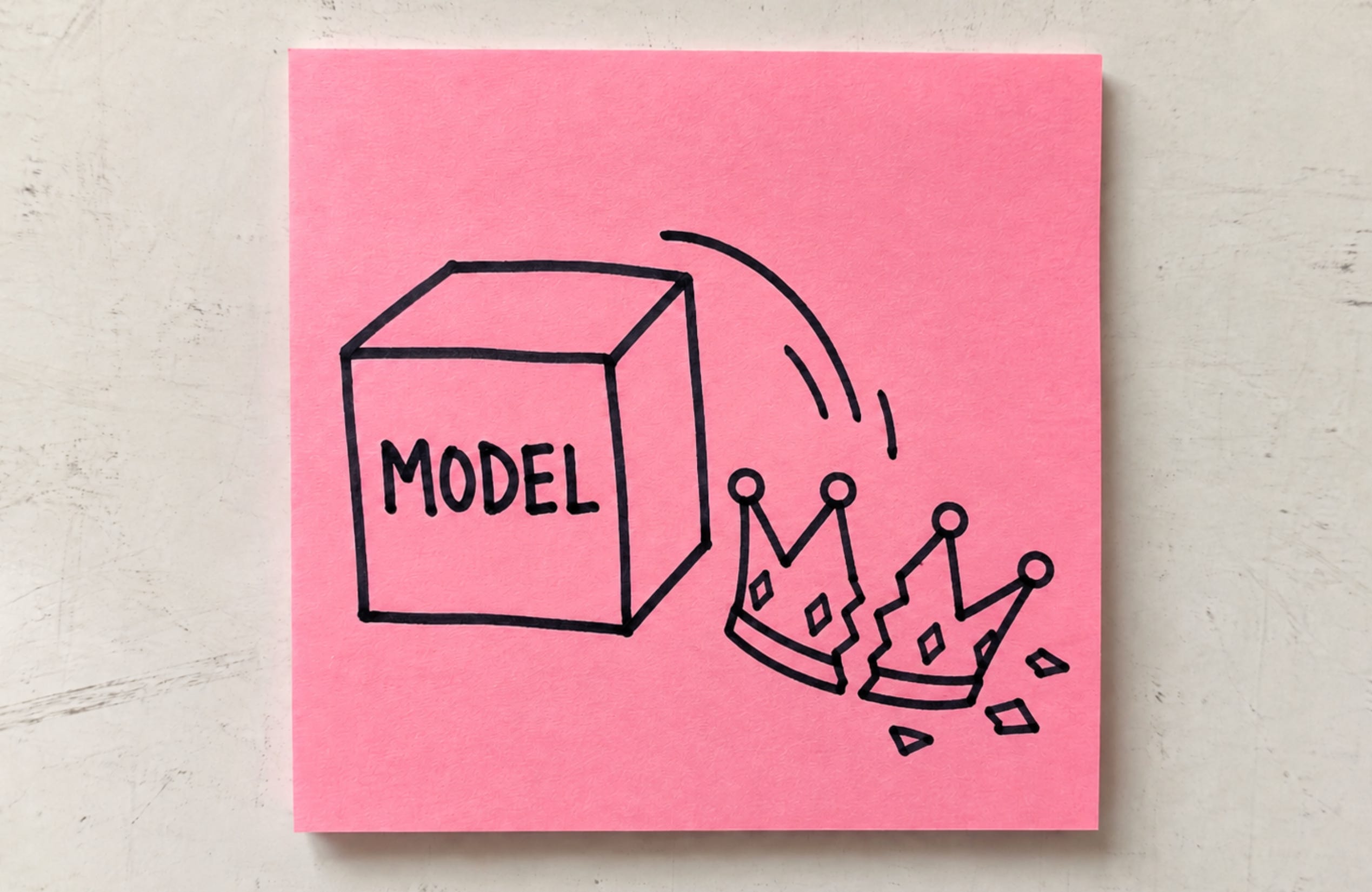
My prior essay described an illusion that’s behind modern design, strategy, and organizational life. It’s the illusion that reality is what we understand conceptually, organize into frameworks, and control through systems. When we become deceived by this illusion, we push Christ to the periphery where He’s no longer the living center, reduced to inspiration, used as moral language, permitted only to speak within the machinery of our conceptual mastery.
This essay goes a little further. The issue is not simply our excessive dependence on abstractions. The real problem is that with our abstractions, we get to have ‘understanding’ without any real encounter, ‘knowledge’ without really ever being known, and ‘mastery’ without humility. We’d rather have a world we explain into existence than the world spoken into existence by the Word.
Frameworks and models give ‘understanding’ without encounter.
Conceptual models and frameworks give us a false sense that we can understand things without actually experiencing them—without the risk of encounter. We see ourselves as knowledgeable, but we haven’t really interacted with what is real. We interpret what we think reality is before we are addressed by it. We speak before we have listened. We’ll fit the world into our categories before we’ll let it confront us. Here is the problem: we seize reality conceptually in our minds before it is received relationally. We speak over the world, silencing its address.
CASE STUDY 03 :: FRAMEWORKS AND MODELS GIVE ‘UNDERSTANDING’ WITHOUT ENCOUNTER.
In 2004, Bank of America was looking for a new way to get more people to open accounts. The goal was straightforward: boost enrollment. This was a typical challenge for banks focused on growth, products, and customer acquisition. Usually, such a challenge would be rendered into customer segments, conversion funnels, incentives, and account-opening strategies.
Letting go of our models.
But Bank of America did something different. Faith Tucker and Ray Chinn formed a team of bankers and designers and purposefully went into the field. They set aside the bank’s conventional models, frameworks, and best practices—all the standard conceptual abstractions in the world of banking. Instead, they listened to families. They observed how people actually spent their money, saved their money, calculated their money, worried about their money, improvised with their money, and tried to stay afloat when they didn’t have enough. They walked alongside mothers in grocery aisles and sat with them at kitchen tables. Rather than tweaking financial products, they entered into people’s financial lives.
And a decisive moment happened.
Encountering hidden wisdom.
They encountered a woman, stewarding her household’s fragile resources. The team looked at her checkbook. She was not performing a ‘savings behavior’ in the abstract language of the bank. She was not moving through a customer journey. She was not asking for a new product feature. She was simply trying to contend with the raw arithmetic of existence, seeking to make life possible in the face of scarcity.
She had a habit. When she spent $22.73, she wrote down $23.00. When she spent $31.35, she wrote down $32.00. She rounded up. It made the math easier. But it also did something else. It created a hidden margin. A few cents here, a few cents there. It added up to a little buffer. She was creating a small sanctuary of protection within the relentless pressure of not-enough.
And there it was. Right there. That one checkbook knew something that banking models didn’t.
The team didn’t ask, “Would you like a debit card that rounds up your purchases and transfers the difference into savings?” As Tim Brown of IDEO later said, “People couldn’t tell us they wanted a debit card that would keep the change. And neither could we. Such a thing never occurred to anyone.”
And yet this one woman’s daily life was quietly shouting something loud and clear. Her checkbook revealed a kind of wisdom that no banking framework had yet generated. She was not just a financially strained customer. She was a maker of hope, fashioning possibility from scarcity. She built a safety net out of pennies. The bank did not create something meaningful here. It encountered it. It was already present, just waiting to be seen.
Design as response, not authority.
The team took that practice as revelation and built a product around it. “Keep the Change” rounded up debit-card purchases to the nearest dollar and moved the difference into savings. The bank later matched some of those savings as an incentive. But the heart of the idea was not the incentive. The heart of the idea was the encountered behavior. The design worked because it did not begin by imposing a theory or a category or a definition of saving. It began by discovering how a woman was already saving.
The results went beyond just money. Faith Tucker later described an effect that was unexpected and deeply emotional. People who had never saved before suddenly had savings, and even the smallest accumulation awakened in people a sense of agency, a restoration of dignity.
This is the difference between the realities we render into existence and the ones we encounter.
Confidently blind.
Rendered reality would have begun with the bank’s categories: low-balance customers, savings resistance, acquisition strategy, account conversion. It would have seen the woman as a target for intervention. And through those abstract categories, it would have missed what was actually, truly real. Instead, encountered reality began with a real woman using a real checkbook in a real creative way to generate real savings and a real sense of hope. It began with the humility to recognize that meaning was already present before the product team arrived.
She was not data. Her actions had their own logic, shaped by intelligence, anxiety, care, hope. Her way of doing things addressed the designers before they translated the meaning out of it with preexisting customer models. The team did not understand her by imposing a model on her life. They understood by allowing her life to interrupt the model.
And this is the danger of frameworks. They can help us describe reality, but they can also shield us from being addressed by it. Frameworks will give us the illusion of understanding, even when we have not truly encountered what is real. They can make us seem fluent in a reality that we haven’t faithfully listened to.
But all the reality around us is not just neutral stuff, inert and waiting for our conceptual frameworks to interpret it. Creation was spoken into existence by God. It already exists as addressed reality.1 It already comes with an inner rationality, spoken into it by the Living Word. It is meaningful before we interpret it. Reality doesn’t need our concepts, models, or frameworks to make it coherent. All things hold together in Christ.2 He is the living center that already gives creation its coherence. Reality is coherent before we ever explain it.
The proper posture toward reality, then, is reception. To receive reality is to let reality disclose itself, to allow its meaning to confront us. This is encounter. It is submission to an already-speaking reality. To bypass encounter—to begin with models, frameworks, maps, and other conceptual abstractions—is to become convinced of an understanding before submitting to what is given. It is to decide meaning before listening. It is to trade listening with control.
When we skip real encounter, we’re essentially stopping our receiving of real reality. We are refusing to be addressed by the reality that is given. And instead of receiving, we possess. We install our models as the source of meaning. And, so, meaning-making authority is quietly transferred to our model. Reality becomes rendered for us before it is encountered by us. It is explained and managed and secured by a model or a framework or some other abstract concept before it is ever received as a gift from God.
What it means to encounter reality.
To encounter reality is to be met by the reality that existed before we showed up to manage it. It is to allow the reality to speak to us before we analyze it, to confront us before we interpret it, to ask something of us before we decide what it means. To encounter reality is to be acted upon. It is destabilizing because it reverses the direction of control.
Encountering reality is never a neutral observation; it is necessarily relational. Something is addressing us, not simply appearing before us. In an encounter, we are not the sole source of meaning. In encounter, reality is not mute or passive. So our understanding of it does not begin when we stand over it; it begins when reality addresses us. It is in this way that reality is received relationally. We do not first decide what it is; we allow it to disclose itself; we let its own inner logic guide our understanding of itself.
This relational reception of reality is theological. If reality can speak to us, if it can disclose itself to us, then it is not silent. If it is not silent, then its meaning is not something we generate. And if meaning is not self-generated, then it must come from beyond us. And it does; reality is relational because it is created through the Living Word. Creation is not an inert product. It is a spoken reality; it was itself brought into being by address, brought into being by God’s spoken Word.
To receive God-spoken reality relationally is to confess that its meaning precedes our abstract concepts, that intelligibility is given to us, not constructed by us, and that the world comes to us having already been interpreted. To receive reality is to receive it from God, who spoke it into meaningful existence.
When we render reality, instead of encountering it.
Rendered reality—reality whose meaning is first rendered by us—is a world made legible by us before it is received as a gift from God. It begins with the premise that the world is raw, neutral, and unarticulated, so we need to step in and give it meaning.
So we render it into visual abstractions like charts, diagrams, maps, and matrices that stand in for lived reality. We render it into categories—personas, segments, and stages that sort human beings into manageable kinds. We render it into measures—metrics, ratios, scores, and bands that decide what counts and what doesn’t. We render it into explanations—models, frameworks, playbooks, and best practices that tell us what is ‘really going on.’
None of these is an innocent description. Each is an act of conceptual possession. They lock the world into a form that promises predictability, control, and order. Once we have rendered reality this way, it no longer addresses us. It behaves for us.
Frameworks and other abstract ideas are safer than real encounters with reality. A conceptual grid is safer than a face because the grid cannot look back at us. A framework is safer than a human-generated business situation because the framework does not demand a response from us. Rendered reality lets us take action from a distance, make decisions without being exposed, and move forward without being personally involved.
CASE STUDY 04 :: WHEN WE RENDER REALITY, INSTEAD OF ENCOUNTERING IT.
Rendered reality.
G. Travis Norvell was the pastor of Judson Memorial Baptist Church in Minneapolis, a church approaching its 110th birthday. Such a milestone beckoned the familiar liturgy of institutional life: campaigns, vision documents, new ministry plans, program calendars, strategies to draw the neighborhood near. That would have been normal for a church accustomed to managing its own existence.
It seems appropriate for church leaders to talk about the neighborhood, to talk about their audience, and to imagine what people need. And then to produce messages, events, initiatives, and outreach plans in response. Leaders will speak of young families, isolated seniors, seekers, skeptics, the unchurched, the overchurched, the spiritually curious, the burned-out. The neighborhood gets rendered into ministry categories. And then we design for the neighborhood we’ve rendered.
Norvell identified this problem plainly. For years, he had sat in his office imagining what the community wanted or needed. “Never did I think I could just ask them.” So he began asking.
He had heard another pastor, David Van Brakle, describe conducting one hundred interviews with people in the community. As Judson’s 110th birthday approached, Norvell decided to attempt 110 conversations with neighbors and community leaders who were not part of Judson Church. He gave himself a year to get it done. Those conversations changed the church’s imagination.
Encountered reality.
Norvell didn’t see it as door-to-door evangelism. It wasn’t a campaign. It wasn’t a clever way to get people into the building. Norvell called it an exercise in “slow church.”
He asked simple questions. Do you know where Judson Church is? Do you know anything about it? What worries you about life in this neighborhood? Where could the church direct its energy?
And the neighborhood Norvell had rendered in his mind began to dissolve, its contours giving way to the presence of real persons.
Some neighbors did not know where Judson was. Some knew it only as the church with the preschool or the playground. One neighbor even praised the “yellow Adirondack chairs” in Judson’s front yard. But Judson did not have yellow Adirondack chairs. Judson didn’t even have a front yard.
Modern management would mistake this for a branding failure. Such a thought never occurred to Norvell. To him, it was a revelation. The church imagined itself present, but the neighborhood could not perceive it. The church believed it was speaking, but no voice was heard. All of Norvell’s coffee-shop conversations with neighbors unveiled a deeper reality: the church had been answering questions posed by church models, audience segments, and discipleship metrics, but not the living questions that dwell in the hearts of neighbors.
This is the seduction of rendered reality: it lets us serve the neighbor of our imagination while remaining estranged from the neighbor God has given.
A ministry plan can be sincere and still address a fictional reality. A church can speak of the neighborhood, pray for the neighborhood, program for the neighborhood, advertise to the neighborhood, yet never receive the neighbor. A rendering of the neighborhood can overflow with compassion, urgency, even theological eloquence. But until the neighbor is permitted to speak, the church may only be loving a projection.
Norvell also asked about worry. And the answers were not abstract conceptual categories. They were not demographic trends. They were not the clean language of a ministry consultant. They were individual, unique pains. “I’m alone.” “I’m exhausted.”
So Norvell repented of his ministry plan. The neighborhood was not a target audience. It was not a mission field rendered for the perfect ministry program. It was not a set of unmet needs waiting for a predesigned ministry path. It was full of unique people, a communion of persons, each bearing loneliness, fatigue, grief, the weight of racial wounds, and the silent ache of estrangement.
Norvell was now listening. No longer speaking.
Repenting from conceptual ministry.
The church does not live by speaking first. It lives because God has already spoken. We listen for the living voice of Christ, and in that listening, the Spirit opens our ears to the neighbor. These are the realities that precede us, that speak to us before we analyze, categorize, model, measure, or possess. Our first act is encounter, not explanation. When the church speaks before being addressed by the Living God and encountered by the neighbor, it degrades into a purveyor of mechanical formulas.
When our speech arises first from demographic segments, ministry models, discipleship pathways, and best practices, it ceases to be faithful theology and becomes mythology. It speaks from a world of our own making, to people we have not received, over neighbors we have not yet known.
Norvell’s efforts weren’t market research. He wasn’t running focus groups. It was repentance from the conceptual models that kept him in his office, that kept him from encounter. It was relinquishing control. Reaching the lost is not managing them as a demographic or placing them inside an evangelistic strategy. The neighbor is not a target audience to be messaged, a segment to be managed, or an object to be moved through a ministry funnel. The neighbor is a real person, distinct, to be received and known.
And all of the time it took Norvell to sit and listen deeply—it was not a retreat from his real work or a necessary step prior to his real work. It was itself an act of faithful mission. It granted the neighbor the space to appear as they actually are, to be encountered.
Of all people, the church is uniquely free to listen, unburdened by the anxieties of processes, systems, and best practices. We listen humbly because we know that the Spirit is already at work, that Christ is already Lord, and that Christ alone is the mediator of both revelation and response (not us, and not our frameworks, models, and systems).
Dethroning abstract fictions.
Rendered reality says: we know what the neighborhood needs. Encountered reality says: ask them. Rendered reality says: build the program. Encountered reality says: sit across the table. Rendered reality says: they are the ‘Sunday Stalwarts’, the ‘God-and-Country Believers’, the ‘Spiritual But Not Religious’, the ‘Religiously Unaffiliated’, the ‘Spiritually Curious.’ Encountered reality says: let them tell you their names.
This is why Norvell’s coffee shop encounters mattered. Evangelism models and discipleship pathways have their place. Organization and strategy are not the enemy. Yet Judson’s ministry began to respond to the truth of its surrounding reality after those conversations. God-addressed truth is the fruit of encounter. The church’s energy was no longer directed by what leaders, church consultants, surveys, or the latest missiology book said people needed, but by the voices of neighbors received as gift.
This is the danger of rendered reality. It allows us to care for people without receiving them. It allows us to speak about the neighborhood without being addressed by the neighbor. It allows us to be fluent in mission while remaining strangers to the people among whom God has placed us.
Once the neighbor is received and speaks, the ministry plan is no longer sovereign. Reality takes precedence over the rendered.
Rendered reality is something we control with intellect, governance, and systems—before it is ever allowed to confront us. Rendered reality is a world we can hold without ever having to be held.
And once a reality that we render becomes our version of what is real, everything that follows is inevitable: systems to enforce the rendering, processes to perpetuate it, dashboards to police it, and a culture that calls this operational excellence, stewardship, maturity, or the mark of serious work.
When God-addressed reality is encountered.
But meaning does not begin when we interpret the world; it begins because the world has already been addressed by God.
The reality that is our world is not silent, awaiting our voice. It exists as something already spoken into being by the Word—by the voice of God—and spoken to again, a second time, in the Incarnation of the Word—the Word made flesh, the Word taking up form and substance inside our very reality. Creation itself comes from the Creator Word already spoken. And creation has then also been met, judged, and reconciled in the Incarnate Word. So, reality is not neutral ground waiting for our interpretation, waiting for our frameworks before it can speak; it is a world already addressed. Twice.
God did not first create stuff and then later assign meaning to it. God created by speaking. Meaning is not added after existence; meaning is woven into existence itself because creation happens through the Living, Spoken Word.
We know that speech isn’t neutral. To speak is to intend, to direct, to give form. And creation happens through speech (“Let there be…”). Therefore, creation is not mute matter; it is meaning-bearing from the start. It comes with intention, direction, and form. Hence, meaning—the meaning already inside the reality around us—precedes our interpretation. We do not generate meaning out of a reality; we encounter it in a reality. Because creation comes from the Spoken Word, it is already intelligible, not because we necessarily understand it, but because the Living Word has already addressed it. This address is what constitutes meaning.
Reality is not first data. It is first gift.3 Not first a problem-space, but a field of meaning held together in Christ. Not first raw material for our models, but a world addressed by God—and therefore capable of addressing us.
This means that we do not start by explaining, but by listening. We do not begin by categorizing; we begin by encountering. We do not begin by measuring; we begin by honoring. We do not begin by imposing form; we begin by receiving form. We do not begin by securing control; we begin by submitting to the truth of a thing as we encounter it.
Because we are dealing with reality addressed by God, the movement is not from chaos to clarity by our methods and models. The movement is from God’s giving to our receiving.
The decisive difference between rendered reality and encountered reality.
Things that we can render into existence are things we can then manage. But things that confront us must be answered.
Our rendered realities are realities secured by our conceptual abstractions, our models, and our frameworks. It is a world made understandable on our terms. But a reality addressed by God and encountered by us is understood on His terms. A God-addressed reality can only be known by receiving it, not through mastering it. Rendered reality—reality as we render it—says reality is what fits our system. Addressed reality—reality addressed by God and encountered by us—says reality is what Christ has already spoken it to be.
Rendered reality requires managers and administrators of a world we make—a world we coerce, through management and administration, into our conceptual model. Such a world forms people who stand over the world, who organize, systematize, optimize, and control reality we first conceptually secure, and then govern from a distance to enforce its conformity.
But when we encounter God-addressed reality, something very different happens. We are formed into people who answer to a reality we did not create, who live under the claim of what has already been given, who answer to the lordship of the Word that spoke reality into existence. Addressed reality forms people who stand under what God has spoken, who receive, answer, and participate in a world that precedes them and claims them.
Rendered reality gives us frameworks that can be applied without conversion, without ever having to change ourselves—change our perspective, change our judgments, change our mind. God-addressed reality gives us a world that cannot be known without repentance, not because reality must change to fit our conceptual model, but because understanding God-addressed reality as it truly is changes us—changes our perspective, changes our judgments, changes our mind.
A God-spoken, incarnationally-claimed reality has something to say to us that we don’t already know. A world addressed by God in Christ is not a silent object we stand over and control, but a reality that makes a claim on us.
And when God addressed reality, He didn’t address reality abstractly. He addressed the world personally and relationally, from within it, through the incarnate Son who assumed our humanity, and as such, speaks as both man to God and as God to man. Through the Incarnate Son, who is both God and man, God addresses the world as its Creator, for the sake of our communion with Him.
That means the world is not merely spoken about; it is spoken to. God speaks to the world in Jesus Christ.4 And because Christ is Himself human—fully human inside our reality—God’s address to reality is simultaneously an address to us. We are not just neutral observers in a world addressed by God; we are participants in it. To encounter such a world, then, is to encounter a reality that already names us, places us, and calls us.
However we encounter, perceive, or come to know such a reality, it is only by setting aside our preconceived notions—our frameworks, models, and maps. We cannot know a God-addressed reality without repentance from our conceptual abstractions.5
This repentance is not a moral add-on in some spiritual-only category of our lives. It is the posture required in our business lives, professional lives, family lives, ministry lives, when true reality challenges our claim to authority. Our rendered realities let us remain in charge, but God-addressed reality puts us under truth we didn’t create. To encounter such a world is to be confronted, displaced, and called to respond—and that response is repentance. Repentance is required because reality addressed by God refuses our sovereignty, displaces our frameworks, exposes our abstractions as evasions of truth, and asks us to surrender control to receive what is true. To know a God-addressed world, we must abandon our posture of mastery. That abandonment is repentance.
God’s address is never just informational. It is relational and covenantal. It creates obligation, not just understanding. God’s address to the world is mediated through Christ, and Christ’s address necessarily includes us. To be addressed by the living God is not merely to be informed, but to be summoned.
We cannot know a world addressed by God from a place of mastery; we can only know it with a spirit of repentance.
Dominion without domination.
The first pages of Scripture don’t flinch from the word ‘rule.’ The Creator gives us dominion. The earth is to be ‘subdued.’ The garden is to be cared for and kept. We were given a real calling. It is active, responsible, and directed toward the world. But it’s not a license for mastery. It’s not permission to stand over reality.
Our modern imagination hears ‘rule’ and thinks control: capture the variables, build the model, enforce the system, reduce the risk. We think dominion is managerial sovereignty, standing over reality with tools that make it predictable. But that would be a post-Fall vision of reality. It assumes the world is a bunch of raw material and the human mind is its rightful governor.
If we want to understand dominion, we’ll need to start with the Incarnation. The command to ‘rule’ finds its meaning in Jesus Christ. God’s way of ruling his creation is not authority by concept. It is steadfast, personal, patient, sustaining, self-giving involvement. It is the Word who upholds all things. It is the Son who enters what he has made. It is the Spirit who gives life from within. God does not manage the world from afar; He enters it, carries it, stays faithful to it, and restores it by drawing near. Dominion is our participation in God’s own way of relating to creation.
We can render creation in our image. That is the implicit expectation of most professional work. Or we can receive it as something God has spoken into being. Before humanity could act at all, the world was already spoken, already structured, already meaningful, already good. The garden was a gift. Adam was placed into a world that already made sense because it was spoken into existence by the Word. Adam’s first act was simply to listen. Humanity’s first vocation was to receive the order already given. We are meant to respond before we produce. We are meant to name things in response to what God has given. We are meant to cultivate according to the grain of creation. Dominion is stewardship of a world first addressed by God; our actions, then, answer to the One who speaks. Adam did not create meaning. He didn’t layer structured frameworks over what was otherwise chaos. He simply cared for the meaning that was already there.
This was dominion. And with the Fall, it was corrupted.
The meaning God spoke into His creation wasn’t erased, but the Fall did distort how we relate to it. Creation wasn’t suddenly turned into chaotic raw material; humanity was turned into a false master.6 Stewardship turned into possession. Naming turned into labeling. Cultivation turned into extraction. And because the world now resists us with thorns, sweat, conflict, strife, and decay, we reach for a substitute salvation: abstraction. Why? Because then we get to render reality into manageable forms where we can act over reality without being exposed by it, decide for reality without being called into it, and fix reality without suffering with it.
But God’s answer to a chaotic world is Jesus Christ, who entered in, became exposed, and suffered. And our answer is better frameworks and systems. God's response to the Fall wasn’t to manage the world from above. He entered the world.7 The Incarnation is God’s way of addressing reality.
And it is God’s way of refusing domination. He didn’t force order from above to redeem creation. He did not create a new system, issue a new framework, or redesign from a distance. He enters the disorder, assumes the brokenness, and carries sin, death, and the burden of a world that just won’t ‘behave.’ And then He heals it from the inside.
The cross is not only forgiveness of sin; it is God’s judgment on every fantasy of redemption by control.8 The resurrection is not only hope for the future; it is the declaration that reality can only be healed by the One who meets it, not by those who manage it.
In the end, we are called to rule, but our rule must be cruciform. We are called to participate in restoration—a restoration that does not mean forcing the world to conform to our conceptual models of order, enforcing coherence through our systems, or reducing chaos through our control. It is a restoration that happens through participation.
It happens when we take action without bypassing encounter. It happens when we design and build with attention, not assertion; obedience, not mastery; patience, not coercion. It takes responsibility for outcomes without pretending the model is sovereign. It builds, repairs, and organizes, but does so as participation in Christ’s reconciling work—not as an attempt to secure the world by conceptual grip. It means sharing in Christ’s way of being with the world. And what is that way? He restores by bearing, reconciling, healing, suffering, and remaining faithful even when there is resistance.
CASE STUDY 05 :: DOMINION WITHOUT DOMINATION.
Human achievement.
In Southern California, the 101 Freeway carves its way through Liberty Canyon in Agoura Hills. This is human achievement, visible and undeniable. It moves commuters, families, workers, students, ambulances, trucks, and goods. It binds cities together. It serves the rhythms of human life. But it also sliced the Santa Monica Mountains apart.
From above, it appears as infrastructure—lines and lanes, a marvel of design. But from the ground, for mountain lions, bobcats, coyotes, gray foxes, mule deer, reptiles, birds, and all the wild kin, the freeway became a wall. A river of noise, velocity, and concrete. The land was no longer one land. Habitat splintered into fragments. Creature movement became dangerous. The mountain, once continuous, became an island.
U.S. 101 separated the Santa Monica Mountains from the Simi Hills and Santa Susana Mountains, dividing what had been continuous habitat into isolated fragments and severely restricting wildlife movement. For mountain lions, that restriction increased inbreeding, territorial conflict, and very low genetic diversity.
This is the face of domination.
Corrupted dominion.
Domination is not the inevitable result of building, nor are roads themselves evil. Domination emerges when human making claims sovereignty. The freeway imposed a singular logic upon the land: human speed. Human movement. Human efficiency. The mountain was rendered as a corridor. Habitat was treated as interruption. Creaturely life was compelled to conform to a world rendered by traffic flow.
Reality encountered.
The National Park Service has studied mountain lions in the Santa Monica Mountains since 2002. The findings were severe. The major freeways had become barriers to movement. The genetic diversity of the Santa Monica Mountains population became among the lowest ever documented for the species. If the mountain lions remained cut off by freeways and development, researchers estimated a 99.7 percent chance of extinction within just fifty years.
The mountain lions could not stand before a planning board and declare, ‘Your road has broken our world.’ They could not name habitat fragmentation, inbreeding depression, dispersal corridors, or extinction risk. Yet they were not silent. Their bodies spoke. Their movements spoke. Their deaths spoke. Their DNA spoke.
And human beings began to listen.
Science is not the adversary of faithful dominion. It is a discipline by which we learn to hear creation truthfully. Scientists tracked the lions. They studied their movements. They mapped corridors. They watched which creatures crossed, which could not, and which died trying. The creaturely world was addressing us, but it had to be received with patience, discipline, and attention.
There was one mountain lion that made the wound visible. His name was P-22. He became known as the “Hollywood Cat.” He somehow crossed two major Los Angeles freeways, the 405 and the 101, and ended up living in Griffith Park, beneath the Hollywood sign. To the city, he became a wonder. A wild creature in the middle of Los Angeles. A sign that wilderness had not entirely disappeared. But his life was also a sign of fracture. Griffith Park was hemmed in by freeways and urban sprawl, and P-22 lived for more than ten years in the smallest home range ever recorded for an adult male mountain lion.
He was famous. But he was stranded.
And this is what rendered reality hides. A freeway map shows lanes, exits, traffic flow, travel time, and congestion. It reveals how human beings traverse space with efficiency. But it does not reveal the creature whose ancestral paths have been severed. It does not reveal the young lion searching for territory and finding only the glare of headlights. It does not reveal a population quietly unraveling because mates cannot reach one another. It does not show the living world turned into isolated fragments by the sovereignty of human speed.
Domination insists: the mountain must yield to the freeway. Dominion confesses: even the freeway can learn how to serve the mountain.
Engineering as repentance.
So, over the 101, people began building the Wallis Annenberg Wildlife Crossing. Caltrans (California Department of Transportation) describes it as a vegetated bridge across U.S. 101, the largest wildlife crossing of its type in the nation. It is designed to provide safe passage, reduce wildlife-vehicle collisions, and allow the exchange of genetic material necessary for wildlife survival.
This is not the rejection of civil engineering. This is engineering brought to repentance.
The bridge is not merely concrete, with animals permitted to pass over it. It is being made as habitat. Soil, native plants, sound walls, local seed, ecological design, and years of research are part of the work. The point was not simply to place a structure over the road. The point was to let the mountains meet again.
Beth Pratt of the National Wildlife Federation said the crossing is “a real extension of the Santa Monica mountains ecosystem.” Then she said, “Even a freeway is redeemable.” That is dominion without domination.
It is not passivity. It is not the refusal to build. It is not a retreat from human responsibility. The bridge itself requires engineering, planning, fundraising, legislation, design, soil science, ecology, and construction. Human beings remain agents. But now their action is answerable to a real encounter. The freeway is no longer allowed to be the final word. The human system must incline itself toward the creaturely world it once disregarded.
This is what it means for human beings to act as priests of creation.
We are priests of creation.
We discern order. We listen to the rationality God has woven into the world. We learn that mountain lions need range, movement, mating, territory, and genetic exchange. We allow creation to tell us what our abstractions have hidden.
And then we set about rectifying the disorder. We name the fact that our own works have wounded the world. We do not baptize fragmentation as progress. We do not call extinction an acceptable cost of efficiency. We repent of the way our dominion has become domination. We institute order. We build differently. We repair. We reconnect. We make a road serve not only human movement but also creaturely movement. We turn concrete, soil, and native plants into a form of reconciliation.
The wildlife crossing is not sentimental nature-love. It is costly, active, intelligent care. It is human making transfigured into service. It is technology disciplined by encounter. It is dominion restored by humility.
The Incarnation teaches us that God does not heal the world by managing it from above. He enters the breach. He bears the wound. He restores from within. In Jesus Christ, divine sovereignty is revealed not as coercive control, but as self-giving, reconciling, life-restoring presence. So our dominion must take that same form.
The mountain lions were never obstacles to progress. They were fellow creatures within a coherent world God has spoken into being. Their movement mattered. Their creaturely life mattered. Their biological diversity mattered. The task was not to dominate the land until only human purposes remained. The task was to receive the land as a shared creation and then act for its healing.
In the end, the freeway remains. Yet it no longer defines the whole reality. That is the difference that matters.
Domination builds a road and declares the wound inevitable. Dominion beholds the wound, tells the truth, enters the breach, and constructs a bridge.
The fallen world is not neutral matter awaiting management. Its disorder is not permission to abstract. Its pain is not justification for domination. Its chaos is not evidence that meaning has gone missing.
This world is already claimed by Christ. It is already addressed by the Word who holds it together. It is already moving—through judgment and mercy—toward new creation. So our task is not to dominate it into order, nor to save reality by force of concept, system, or control. Our task is to serve what Christ is already redeeming. That is the meaning of dominion. It is participation in God’s own way of relating to creation: receiving before ruling, listening before naming, entering before ordering, bearing before repairing.
This is why our frameworks and models can become so dangerous. Not because structure is evil or careful thought is unfaithful. But because abstraction so easily becomes avoidance. It offers speed instead of patience, control instead of vulnerability, safety instead of obedience. It lets us ‘fix’ the world without suffering with it.
Humanity was never called to force order onto a meaningless world. We were called to care for a world already spoken into being by God. The Fall did not erase that meaning; it distorted our posture toward it. And God’s answer to that distortion was not a new system of control, but the Incarnation—a restoration accomplished through faithful presence.
Management tries to secure creation without suffering.
We have seen that the decisive difference is not between simple and complex models, or between good and bad frameworks, but between two ways of relating to the world. Rendered reality is something we secure and manage on our terms. Encountered reality is received from God and answered on His terms. A world addressed by God cannot be known without repentance. It’s a world that refuses our sovereignty.
But there is still a more radical claim I want to make. It is not enough to say that reality is addressed by God in general. We need to show how this address has taken real, historical, flesh-and-blood form. That is the focus of the next essay: to show that the Incarnation is not just another religious idea, but a complete reversal of the abstract-first way of knowing.
Thanks for reading Christ-Centered Design! This post is public, so feel free to share it.
Creation is not mute matter awaiting our interpretation; it is reality already spoken by God.“And God said, ‘Let there be light,’ and there was light.” —Genesis 1:3. “By the word of the Lord the heavens were made.” —Psalm 33:6. Scripture presents creation not as neutral material later assigned meaning, but as reality brought forth through divine speech itself. Meaning is not added after existence; existence is constituted through God’s speaking. The world is therefore intelligible before our frameworks interpret it because creation already bears the rationality, order, and intention of the One who spoke it into being.
Christ is not merely related to reality; He is the living coherence of reality itself.“He is before all things, and in him all things hold together.” —Colossians 1:17. “He upholds the universe by the word of his power.” —Hebrews 1:3. The Christian claim is not that Christ later enters an otherwise self-standing world, but that creation is continuously sustained, ordered, and held together in Him. Reality does not become coherent because our models explain it; it is coherent because the living Christ actively sustains it.
Christ is not an overlay added to reality; He is the source, meaning, and end of reality itself.“For by him all things were created… all things were created through him and for him.” —Colossians 1:16. “For from him and through him and to him are all things.” —Romans 11:36. The world is not first self-standing and then later interpreted religiously. Reality already comes from Christ, exists through Christ, and moves toward Christ. This overturns the illusion that our concepts possess reality before Christ does.
The living God addresses creation personally through the incarnate Son.“Long ago… God spoke to our fathers by the prophets, but in these last days he has spoken to us by his Son.” —Hebrews 1:1–2. “My sheep hear my voice.” —John 10:27. God’s speech is not abstract communication about reality; it is personal address within reality. In Christ, God does not merely explain the world. He enters it, speaks within it, and summons humanity into communion and response.
Reality addressed by God cannot be known from a posture of mastery; it can only be known through repentance.“Be transformed by the renewal of your mind.” —Romans 12:2. “Take every thought captive to obey Christ.” —2 Corinthians 10:5. Repentance is not merely moral regret; it is the surrender of self-authorizing thought. To know rightly requires relinquishing the illusion that reality belongs first to our conceptual control. True understanding begins when the mind itself comes under the judgment and renewal of Christ.
The Fall did not erase creation’s meaning; it distorted humanity’s relationship to it.“Cursed is the ground because of you.” —Genesis 3:17. “The creation was subjected to futility.” —Romans 8:20. Scripture does not present the world as meaningless after the Fall, but as fractured and resistant under sin. The distortion occurs primarily in humanity’s posture: stewardship becomes possession, cultivation becomes extraction, and dominion becomes domination.
God redeems creation not from a distance, but from within its very condition.“And the Word became flesh and dwelt among us.” —John 1:14. “He humbled himself by becoming obedient to the point of death.” —Philippians 2:8. The Incarnation is God’s refusal to remain abstract. In Jesus Christ, God enters the disorder, suffering, and resistance of creation personally. Redemption, therefore, happens through participation, presence, and bearing, not through detached control.
God heals creation by entering its suffering, not by controlling it from afar.“Surely he has borne our griefs and carried our sorrows.” —Isaiah 53:4. “In Christ God was reconciling the world to himself.” —2 Corinthians 5:19. The cross reveals that redemption is accomplished through self-giving participation within the brokenness of the world. Christ bears sin, suffering, and death rather than abstracting Himself above them. Every dream of salvation through technique, management, or conceptual control stands judged beneath the crucified Lord.